
Improving service agency margins isn’t about finding new clients or raising prices; it’s about declaring a ruthless war on the hidden operational waste you already have.
- “Waiting” and rework from “custom” requests are not costs of doing business—they are quantifiable profit leaks.
- Standardization through SOPs and disciplined systems (like Digital 5S) is the primary weapon against this waste.
Recommendation: Start by measuring one form of waste, like idle time between tasks, and systematically eliminate its root cause.
For a service-based business, the pressure on profit margins is constant. The conventional responses are to raise prices or chase more clients, both of which have finite limits and introduce new complexities. This approach is flawed because it ignores the most significant opportunity for profit growth: the systematic elimination of internal waste. Most agencies are leaking profit through inefficient processes, rework, and delays, treating them as unavoidable “costs of doing business.” They are not. They are forms of operational waste, or *Muda*, a concept borrowed from lean manufacturing.
The common advice to “use better tools” or “improve communication” misses the point. These are symptoms, not the disease. The disease is variation and non-value-added activity. True operational efficiency is not about working harder; it is an analytical, ruthless hunt for waste in every corner of your operations. It means applying engineering principles to processes that are often treated as purely creative or chaotic. This requires a fundamental shift in mindset: from simply managing tasks to engineering systems that make waste and errors impossible.
This article will not offer platitudes. It will provide a systematic framework for identifying and eradicating the most destructive forms of waste in a service business. We will dissect the true cost of waiting, the critical role of standardization, how to make strategic automation decisions, and how these operational tactics translate directly into improved fiscal health. The goal is to re-engineer your agency’s engine for maximum output with minimum friction, boosting margins without adding a single dollar to your price list.
This guide will walk you through a structured approach to operational excellence. Each section targets a specific form of waste and provides a clear methodology for its elimination, allowing you to build a more resilient, scalable, and profitable service business.
Summary: A Lean Framework for Service Business Profitability
- Why “Waiting” Is the Most Expensive Waste in Your Office?
- How to Write SOPs That Employees Actually Read and Follow?
- Automate or Outsource: Which Solution Solves the Bottleneck Cheaper?
- The Hidden Cost of “Custom” Work: Why Standardization Increases Profit?
- Digital 5S: Organizing Your Shared Drive for Maximum Speed
- How to Plan a Cloud Migration for Legacy Apps Without Downtime?
- Why Focusing on Logos Before Logistics Delays Launches by Weeks?
- How to Drive Fiscal Health by Optimizing Gross Margins?
Why “Waiting” Is the Most Expensive Waste in Your Office?
In a service business, time is the inventory. Unlike a factory, you cannot stockpile hours. Once an hour is wasted, it is gone forever. The most insidious form of this waste is “Waiting.” This includes time spent waiting for approvals, for information from a colleague, for a client to provide assets, or for a slow system to respond. Each minute of waiting is a direct drain on your most valuable resource: billable capacity. This isn’t just a minor inefficiency; it’s a colossal financial hemorrhage. In fact, Harvard Business School research reveals that idle time costs American businesses up to $100 billion annually.
This waste is compounded by a psychological phenomenon known as the “deadtime effect.” Research shows that when employees anticipate idle time, their work pace slows down in advance, and task completion time increases. Across 29 occupations studied, 78% of employees reported experiencing idle time. This means the cost of waiting is not just the idle period itself, but also the decreased productivity that precedes and follows it. It infects the entire workflow, creating a culture of lethargy and inefficiency.
To combat this, you must first make the waste visible. Calculating the cost of idle time is not an abstract exercise; it is a critical diagnostic. The formula is simple: (Number of Employees) x (Average Fully-Loaded Hourly Rate) x (Hours Wasted Weekly) x 52. Seeing this number in black and white transforms an abstract frustration into a tangible, high-priority business problem. The first step to operational efficiency is to declare war on waiting. It requires mapping your processes to identify every handoff and approval gate—these are your primary targets for elimination or optimization. Any step where work stops is a defect in your system.
How to Write SOPs That Employees Actually Read and Follow?
The primary defense against the waste of defects, rework, and variation is the Standard Operating Procedure (SOP). However, most SOPs are useless. They are lengthy, text-heavy documents stored in a forgotten folder, written once and never referenced again. A useless SOP is itself a form of waste—the waste of over-production. The goal is not to *have* SOPs; the goal is to have a standardized process that is flawlessly executed every time. The SOP is merely the tool to achieve that outcome.
For an SOP to be effective, it must be engineered for consumption by a distracted, busy employee. The principle is to create a “Minimum Viable SOP” that is graphical, concise, and integrated directly into the workflow. Think checklists, not novels. Use flowcharts, screenshots with annotations, and short video clips. The format must match the task. A complex software configuration deserves a screen-recording, while a client onboarding process is best served by a simple, interactive checklist within your project management tool.
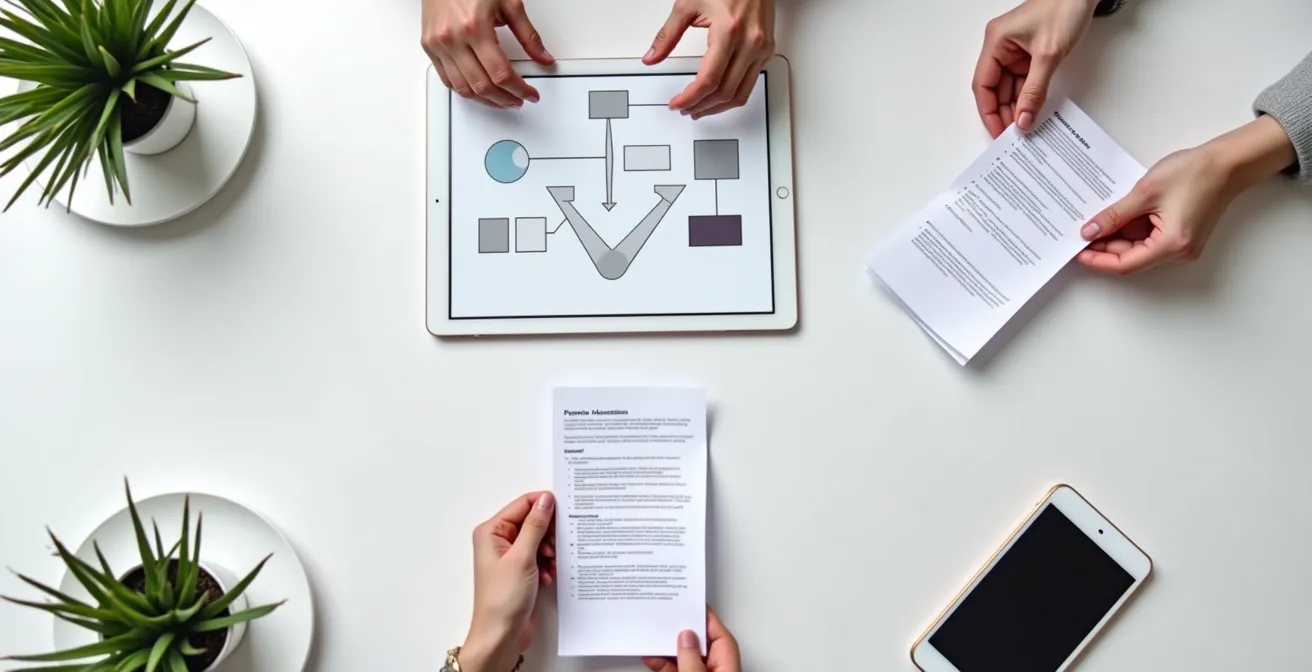
The rising adoption of dedicated tools reflects this need for better systems; indeed, the SOP software market is projected to grow from $5.1 billion to $12.3 billion by 2033. But a tool is not a strategy. The strategy is to involve the people who do the work in creating and maintaining the SOP. They are the experts. Have them document the process as they execute it. This ensures the SOP reflects reality, not an idealized version of the workflow. The final step is to make it impossible to ignore. Integrate the SOP into the task template. An employee should not be able to mark a task as “complete” without checking off the steps defined in the SOP.
Automate or Outsource: Which Solution Solves the Bottleneck Cheaper?
Once you have standardized a process, you can identify the true bottlenecks—the constraints that dictate the pace of your entire operation. A common, undisciplined reaction is to either throw more people at the problem or buy the first automation tool that makes a good sales pitch. Both are gambles. The correct approach is an analytical decision based on two factors: task frequency and complexity. This is not a matter of opinion; it is a matrix-based decision.
High-frequency, low-complexity tasks are the prime candidates for automation. This includes activities like data entry, report generation, or client notification. The goal of automation here is not just speed but the total elimination of human error, a significant form of waste. Conversely, low-frequency, high-complexity tasks, such as specialized legal reviews or advanced technical analysis, are often best outsourced to a specialist. This gives you access to expert knowledge without the crippling cost of a full-time hire, avoiding the waste of under-utilized talent.
The following decision matrix provides a clear framework for these choices. In professional services, where people are the highest cost, optimizing their workload is paramount. Every hour saved from a repetitive task is an hour that can be reinvested in high-value, billable work.
| Task Type | Frequency | Complexity | Recommended Solution | Key Benefit |
|---|---|---|---|---|
| Routine Data Entry | High | Low | Automate | Eliminate human error |
| Specialized Analysis | Low | High | Outsource to Specialist | Expert knowledge without full-time cost |
| Customer Support | High | Medium | Hybrid (Chatbot + Team) | 24/7 availability with human escalation |
| Strategic Planning | Low | High | In-house Development | Maintain competitive advantage |
The medium-complexity, high-frequency tasks, like tiered customer support, often benefit from a hybrid approach. An automated system (like a chatbot) handles the bulk of simple queries, freeing up the human team to manage complex escalations. This isn’t about replacing people; it’s about elevating them to work on problems that require human intellect, thus maximizing the value of your payroll.
The Hidden Cost of “Custom” Work: Why Standardization Increases Profit?
The phrase “every client is unique” is one of the most destructive myths in the service industry. While client goals may be unique, the processes to achieve them rarely are. The obsession with bespoke, “custom” work for every project is a primary source of variation. And variation is the enemy of quality, speed, and profit. Every deviation from a standard process introduces risk: the risk of error, the risk of delay, and the risk of forgotten steps. This results in the waste of rework, defects, and extensive quality assurance cycles, all of which decimate your margins.
Consider the typical service firm. The benchmark for healthy operations is high; most professional service firms achieve 25-40% operating profit margins. This buffer is rapidly eroded by the hidden costs of customization. Custom work prevents the development of expertise through repetition. It makes accurate quoting nearly impossible. It complicates handoffs between team members and makes it difficult to train new hires. It turns your business into a series of one-off projects instead of a scalable system.
The solution is not to offer a one-size-fits-all service. It is to adopt a “productized service” mindset. This means deconstructing your offerings into standardized modules with predefined processes, timelines, and deliverables. Client customization occurs at the *selection and combination* of these modules, not at the *execution* level. For example, instead of offering “website design,” you offer a “Core 5-Page Site Package” (Module A), an “E-commerce Add-on” (Module B), and a “Blog Integration Package” (Module C). Each module has a fixed process and price. The process is standardized; the final combination is unique to the client. This approach radically reduces variation, enabling you to build a true delivery engine.
Digital 5S: Organizing Your Shared Drive for Maximum Speed
The “shop floor” of a service business is its digital workspace: shared drives, project management tools, and communication channels. A disorganized digital environment is a massive source of waste, primarily the waste of “Motion” (unnecessary searching for files) and “Defects” (using the wrong version of a document). The time employees spend searching for information is non-value-added time that the client does not pay for. A clean, organized digital workspace is as critical to efficiency as a clean assembly line is to a manufacturer.
To solve this, we apply the 5S methodology, a Lean tool for workplace organization, to the digital realm. 5S stands for Sort, Set in Order, Shine, Standardize, and Sustain. This is not a one-time cleanup; it is a continuous system for maintaining order and efficiency. A disorganized shared drive is a symptom of a lack of system. Implementing Digital 5S creates that system, making information retrieval instantaneous and error-proof.

The process is straightforward but requires discipline. It begins with a ruthless audit (Sort) and progresses to creating an unchangeable, logical structure (Set in Order). Standardizing naming conventions is non-negotiable, as it turns searching into a predictable action rather than a guessing game. The final—and most difficult—step is Sustain, which involves building habits and conducting regular audits to prevent the system from degrading back into chaos. This is about engineering a system where the correct way to file a document is also the easiest way.
Action Plan: Digital 5S Implementation
- Sort: Audit all files and delete duplicates, outdated versions, and irrelevant documents.
- Set in Order: Create a standardized folder structure (e.g., /Clients/[Name]/[Project]/[01_Contracts, 02_Inputs, 03_WIP, 04_Deliverables]).
- Shine: Schedule quarterly digital cleanups and archive old projects to keep the active workspace clean.
- Standardize: Document and enforce naming conventions (e.g., YYYY-MM-DD_ClientName_ProjectType_Version).
- Sustain: Assign digital workspace champions to oversee the system and conduct monthly audits for compliance.
How to Plan a Cloud Migration for Legacy Apps Without Downtime?
Legacy applications and on-premise infrastructure are significant sources of operational waste. They represent the waste of “Excess Processing” (maintaining outdated systems) and are a common cause of “Waiting” (due to slow performance and downtime). The maintenance burden of these systems consumes valuable technical resources that could be focused on client-facing innovation. Migrating to the cloud is not just a technical upgrade; it is a strategic move to eliminate this waste and enhance operational agility.
The fear of downtime during migration is a major deterrent, but it is a solved problem. Modern migration methodologies are designed specifically to facilitate a seamless transition. A proven technique is the Strangler Fig Pattern. Instead of a risky “big bang” migration, you incrementally build new cloud-native services that “strangle” the old legacy system. You redirect traffic to the new services piece by piece. Over time, the legacy system shrinks in functionality until it can be safely decommissioned. This approach minimizes risk and ensures zero downtime for the end-user.
The business case for this is overwhelming. The global cloud migration services market is projected to reach USD 29.2 billion by 2028, driven by the clear operational benefits. Organizations are not just moving servers; they are buying speed, reliability, and scalability while offloading the non-value-added work of infrastructure maintenance. A well-planned migration is a direct investment in operational efficiency, freeing up capital and human resources to focus on core business activities.
Why Focusing on Logos Before Logistics Delays Launches by Weeks?
A frequent and costly form of waste in project-based services is the waste of “Incorrect Processing Order.” This occurs when teams prioritize low-impact, often aesthetic, tasks over the critical-path activities required for delivery. The classic example is spending weeks debating a logo design or color palette while the core logistical or technical architecture—the project’s backbone—remains undefined. This is a failure of project governance and a misunderstanding of dependencies.
Every project has a Critical Path: a sequence of tasks that directly determines the project’s total duration. Any delay in a critical path task results in a delay for the entire project. Non-critical tasks, like finalizing a logo, can often be done in parallel and have float, meaning they can be delayed without affecting the final deadline. Focusing team energy and meetings on non-critical items while a critical path task is stalled is a cardinal sin of project management. It creates the illusion of progress while guaranteeing a launch delay.
The solution is to adopt a ruthless Critical Path Priority Framework. Before work begins, all tasks and their dependencies must be mapped. The critical path must be identified and made visible to the entire team. Resources—especially your most skilled people—must be assigned to critical path tasks first. Aesthetic and other non-critical tasks should be scheduled for parallel work streams or addressed only after the core functionality is locked down.
This requires discipline from both the agency and the client. It means educating the client that progress on the “look and feel” is irrelevant if the underlying “engine” is not being built. Weekly reviews must focus exclusively on the status of critical path items. This analytical approach replaces emotional decision-making with a logical system focused on one thing: on-time delivery.
Key Takeaways
- Operational waste, especially “Waiting” and “Variation,” is the single biggest enemy of profit margins in a service business.
- Standardization is not the opposite of quality; it is the prerequisite for it. Use “productized” modules and minimalist SOPs to eliminate variation.
- All operational decisions, from automation to project priorities, must be made through analytical frameworks, not intuition.
How to Drive Fiscal Health by Optimizing Gross Margins?
The ultimate purpose of enhancing operational efficiency is to improve the fiscal health of the business. The most direct measure of this is the gross margin—the difference between revenue and the cost of delivering your services. Every form of waste discussed—waiting, rework, defects, unnecessary motion—is a direct attack on your gross margin. It increases the cost of delivery without increasing the value to the client.
The link between operational improvements and financial outcomes is not theoretical; it is directly measurable. For instance, migrating to the cloud is an operational decision with clear financial benefits. Studies show that cloud adoption reduces operational downtime by 57%, directly combating the waste of “Waiting.” This translates into more available billable hours and higher revenue capacity. In fact, 80% of organizations report improved operational performance after cloud migration, which correlates with a 26% average increase in revenue.

Driving fiscal health, therefore, is not a separate activity from managing operations. They are two sides of the same coin. Your P&L statement is simply a financial reflection of your operational processes. A high cost of goods sold (COGS) for a service firm is a sign of inefficient, wasteful processes. By systematically identifying and eliminating waste, you directly reduce your COGS, which in turn increases your gross margin on every single project. This is how you build a scalable, resilient business—not by working more, but by wasting less.
The principles outlined are not theoretical. The next logical step is to select one process within your agency and apply this framework. Identify the waste, measure its cost, and systematically eliminate it. That is how fiscal health is engineered.