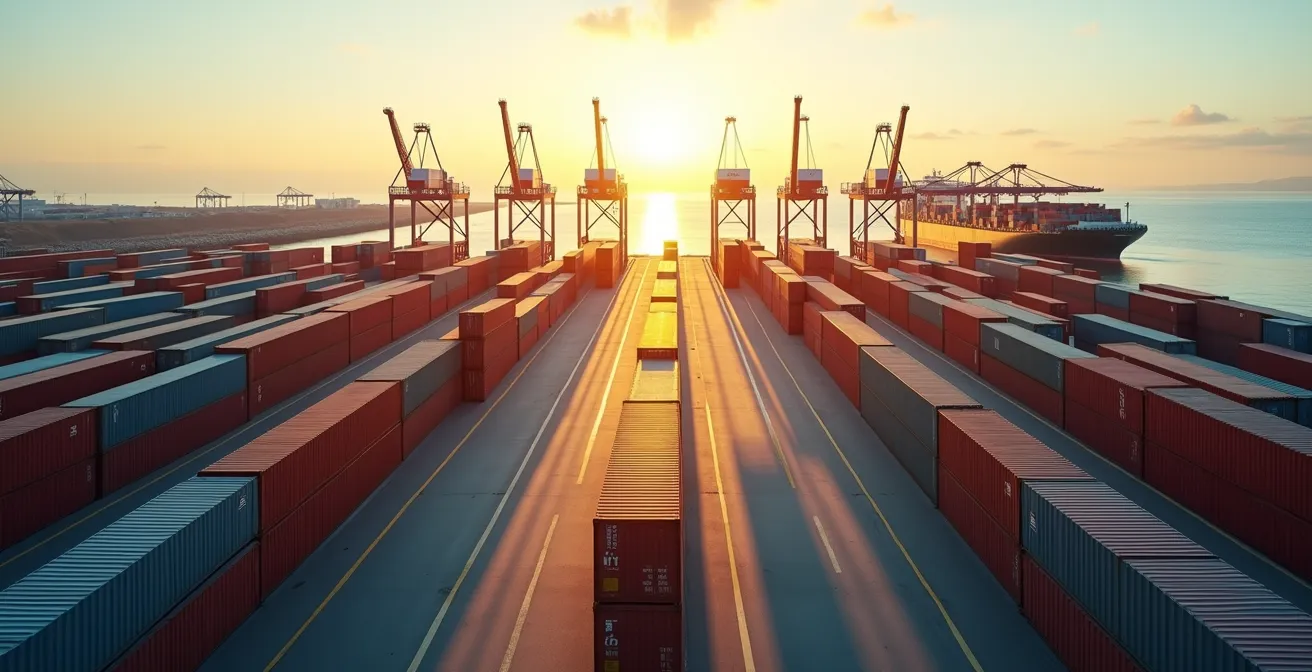
Most customs delays aren’t caused by last-minute paperwork errors, but by strategic flaws baked into your export plan from day one.
- The Incoterm you choose isn’t a logistical detail; it’s a binding contract that allocates all cost, risk, and control.
- Rigorous, proactive screening of foreign buyers is non-negotiable to avoid devastating federal sanctions.
- Payment security tools like Letters of Credit are only as safe as the documentation supporting them is precise.
Recommendation: Shift from a reactive, task-based approach to building a proactive “system of controls” that manages risk far upstream from the border.
For a manufacturer with an exceptional product, the global market represents a vast frontier of opportunity. Yet, this frontier is guarded by a complex and often unforgiving barrier: customs. Many entrepreneurs view customs delays as an unavoidable cost of doing business, a frustrating mix of bureaucracy and bad luck. They focus on filling out forms correctly and finding the right HS codes, believing that diligence at the border is the key to success. This is a critical misunderstanding.
The truth is, most catastrophic delays and financial losses are not born in the chaotic moments of customs clearance. They are the predictable result of poor strategic decisions made months earlier. The common advice to “get your paperwork right” treats a symptom, not the disease. The disease is a weak or non-existent strategic framework for managing international trade. A truly robust export plan isn’t a checklist of documents; it’s a pre-emptive compliance architecture designed to mitigate risk at every stage of the process.
This guide moves beyond the tactical and into the strategic. We will not just list tasks; we will dissect the strategic levers you must pull to make cross-border trade a predictable, profitable extension of your business. It is about shifting your mindset from hoping for a smooth clearance to engineering one. By building a system of controls around buyer selection, payment terms, logistics, and market entry, you transform customs from a source of anxiety into a manageable variable.
This article provides a structured approach, breaking down the critical components of a resilient export strategy. Each section addresses a key decision point, offering the rigorous perspective of a compliance officer to help you build a plan that not only opens new markets but also protects your business from the significant risks involved.
Summary: A Manufacturer’s Guide to a Resilient Export Strategy
- Why Choosing the Wrong Incoterm Can Cost You the Entire Shipment?
- How to Screen Foreign Buyers to Avoid Federal Sanctions?
- Direct Export vs Distributor: Which Model Protects Your Margins?
- The Letter of Credit Solution: Securing Payment Before Shipping
- Redesigning Packaging for Export: Reducing Volume and Breakage
- Reducing Cross-Border Logistics Costs by 20% Through Regional Hubs
- How to Source Local Suppliers When You Have Zero Network?
- How to Leverage Local Joint-Ventures Without Losing Strategic Control?
Why Choosing the Wrong Incoterm Can Cost You the Entire Shipment?
The selection of an International Commercial Term, or Incoterm, is the single most critical upstream decision in any export transaction. It is not a minor logistical detail; it is the foundational legal agreement that defines precisely where risk, cost, and responsibility transfer from you, the seller, to the buyer. A misunderstanding here can lead to a cascading failure, where you are held liable for costs, damages, or even the total loss of a shipment you believed was no longer your problem.
For instance, choosing Ex Works (EXW) may seem attractive as it minimizes your upfront effort; the buyer handles everything from your factory door. However, this cedes all control over the logistics chain and the customer experience. Conversely, selecting Delivered Duty Paid (DDP) offers a premium service but saddles you with maximum risk and financial obligation, including navigating the complexities of the destination country’s customs regime. The choice is a strategic lever, balancing your risk tolerance, cash flow, and the level of service you wish to provide.
The key is to match the Incoterm to your operational capabilities and risk appetite. For a manufacturer new to exporting, an option like Free Carrier (FCA) often provides a good balance. You are responsible for export clearance and delivering the goods to the carrier nominated by the buyer, but your risk ends once the goods are on board. This gives you control over the initial, critical export leg without exposing you to the uncertainties of international transit and import.
This comparative table breaks down the distribution of risk and responsibility for the most common Incoterms, providing a clear framework for this crucial decision. As an official resource, it is vital to know your Incoterms thoroughly before committing to any sales contract.
| Incoterm | Seller Risk Level | Cash Flow Impact | Customs Responsibility | Best For |
|---|---|---|---|---|
| EXW | Minimal | Low upfront cost | Buyer handles all | Established relationships |
| FCA | Low-Medium | Moderate | Seller: export only | Balanced approach |
| FOB | Medium | Moderate | Seller: export clearance | Sea freight transactions |
| DDP | Maximum | High commitment | Seller: all customs | Premium service offering |
How to Screen Foreign Buyers to Avoid Federal Sanctions?
In the excitement of securing an international order, the most dangerous oversight a new exporter can make is failing to rigorously vet the buyer. This isn’t about commercial creditworthiness; it’s about national security and regulatory compliance. Shipping your product to a person, company, or even a country on a government sanctions list (such as the Entity List or Denied Persons List) can result in severe penalties, including crippling fines, loss of export privileges, and even criminal charges. “I didn’t know” is not a defense.
Building a robust system of controls for buyer screening is therefore non-negotiable. This process must go beyond a simple name check. A comprehensive screening protocol involves several layers. First, check the potential buyer and all associated parties (like the end-user and consignee) against the consolidated screening lists maintained by government agencies. Second, investigate the buyer’s beneficial ownership to uncover any hidden stakeholders who may be sanctioned entities. Third, analyze their business activities and location to flag any risk of product diversion to prohibited destinations.
The illustration below captures the collaborative and meticulous nature of this compliance work. It’s a human-driven process of careful analysis, not a simple software check.

A zero-trust approach is the most prudent. One U.S. electronics manufacturer avoided sanctions by implementing a process that included third-party database verification of ownership and analysis of historical trade patterns. This proactive compliance architecture prevented a shipment to a company that was later added to the Entity List, saving them from potentially business-ending penalties. This level of diligence is the standard you must aim for.
Direct Export vs Distributor: Which Model Protects Your Margins?
Once you’ve confirmed a target market is viable and buyers are legitimate, the next strategic decision is your channel-to-market. The two primary models are exporting directly to the end customer or partnering with a local distributor. This choice has profound implications for your profit margins, brand control, and speed of market penetration. There is no single correct answer; the optimal choice depends on your product, capital, and long-term goals.
Direct exporting offers the highest potential margin, as you eliminate the middleman. You maintain complete control over branding, pricing, and the customer relationship. However, this model also carries the highest burden. You are responsible for all marketing, sales, logistics, customer service, and regulatory compliance in a foreign market. For a manufacturer new to exporting, this can be an overwhelming and capital-intensive undertaking.
Partnering with a local distributor, conversely, provides immediate market access and logistical expertise. The distributor handles importation, warehousing, marketing, and sales, significantly reducing your operational load. The trade-off is a lower margin and reduced control over how your product is positioned and sold. A poor distributor can damage your brand reputation and limit your growth potential. This is a significant factor in a growing market, as U.S. exports grew by $185.7 billion in the last recorded year, indicating substantial opportunities.
A prudent approach is often a phased one. You might begin with a distributor to learn the market dynamics and build initial sales volume. As you gain experience and revenue, you can transition to a hybrid model, handling key accounts directly while the distributor serves smaller customers. Eventually, you may have the resources and knowledge to establish your own direct sales presence, fully capturing the market’s value.
The Letter of Credit Solution: Securing Payment Before Shipping
Securing payment is the ultimate form of risk mitigation in exporting. For new relationships where trust has not yet been established, a Letter of Credit (L/C) is a powerful tool. It is a guarantee from the buyer’s bank to pay you once you have presented a specific set of documents proving you have shipped the goods according to the agreed-upon terms. In theory, it replaces the buyer’s credit risk with the bank’s credit risk. In practice, it is a minefield of procedural detail where absolute precision is required.
The primary danger of an L/C is the high rate of documentary discrepancies. Banks deal in documents, not goods. If your paperwork—the commercial invoice, bill of lading, certificate of origin—contains even a minor error (a typo, a mismatched date, a missing signature), the bank can declare a discrepancy and refuse to pay. Shockingly, the first presentation documentary discrepancy rate can be as high as 70%, leaving the exporter unpaid and their goods in limbo at a foreign port.

This highlights the need for a rigorous internal document review process before submission. Every detail on every document must align perfectly with the requirements stipulated in the L/C. To further protect yourself, you can use a “confirmed” L/C, where a bank in your own country adds its guarantee of payment. An even more advanced strategy is “silent confirmation,” where your bank provides this guarantee without the buyer’s knowledge, as a private backstop. One export bank successfully used this to pre-clear potential discrepancies, ensuring payment even when technical issues arose.
While L/Cs provide security, they are complex and demand meticulous attention to detail. Never treat the documentation as a mere formality. It is the very key that unlocks your payment. The process demands a level of scrutiny akin to a forensic audit, as every word and number must be flawless.
Redesigning Packaging for Export: Reducing Volume and Breakage
Packaging for export is a strategic discipline, not an afterthought. It directly impacts three critical areas: logistics costs, product integrity, and customs compliance. Simply using your domestic packaging is a common but costly mistake. International shipping is a harsh environment, and the financial model is different, heavily influenced by volumetric weight.
The first priority is protection. Your product will be handled multiple times, subjected to vibration, impacts, and temperature swings. Breakage not only results in a direct loss but can also lead to complicated insurance claims and a damaged customer relationship. Packaging must be engineered to withstand the entire transit journey. This involves selecting appropriate materials—such as molded pulp or corrugated dividers—and conducting rigorous testing, including drop tests and vibration simulations.
The second priority is cost reduction. Air freight and ocean freight are often priced based on dimensional weight (DIM), which is a calculation of a package’s volume. A large, lightweight box can cost more to ship than a small, heavy one. Redesigning your packaging to be more compact, eliminating empty space, and using lightweight void-fill can lead to significant cost savings on every shipment. Optimizing for DIM weight is a critical lever for protecting your margins.
Finally, packaging is a component of compliance. Many countries have specific regulations on packaging materials. For example, any solid wood packaging material must be treated and stamped according to ISPM 15 standards to prevent the spread of pests. Packaging must also bear the correct handling symbols, country of origin markings, and any other labels required by the destination country. Failure to comply can result in your shipment being rejected, fumigated at your expense, or destroyed.
Your Action Plan: Export Packaging Optimization
- Calculate dimensional weight (DIM) pricing: Measure L x W x H and divide by the carrier’s DIM factor to optimize box sizes.
- Incorporate compliance markings from the start: Add ISPM 15 stamps for wood packaging and multi-language handling instructions.
- Select sustainable materials: Use recyclable or biodegradable materials that meet potential destination regulations, such as those in the EU.
- Conduct shakedown testing: Simulate a 48-hour vibration test, multiple drops from a height of 1 meter, and temperature cycling from -20°C to 50°C.
- Document everything: Create photographic evidence of your standard, compliant packaging process to support potential damage claims.
Reducing Cross-Border Logistics Costs by 20% Through Regional Hubs
For manufacturers scaling their export operations, the traditional model of shipping directly from the factory to each individual country can become inefficient. A more advanced and cost-effective strategy is the development of a regional distribution hub. This “hub-and-spoke” model involves shipping products in bulk to a strategically located central warehouse in a key region (e.g., Singapore for Asia, the Netherlands for Europe) and then performing final distribution to nearby countries from that hub.
The primary benefit is a significant reduction in logistics costs. Consolidating shipments into full containers for the long-haul leg is far cheaper per unit than multiple smaller shipments. From the hub, you can then use more affordable regional ground or short-sea freight for last-mile delivery. This strategy also reduces customs clearance events, as you are managing one large import into the hub region rather than dozens of smaller ones into various countries. This can be particularly effective when the hub is located in a country with favorable Free Trade Agreements (FTAs), which can further streamline processes.
This model also offers powerful strategic advantages in inventory management and market responsiveness. By holding generic, un-customized inventory at the hub, you can implement a postponement strategy. Final assembly, labeling, or kitting specific to local market requirements can be done at the hub just before final delivery. This drastically reduces inventory risk and allows you to respond to shifts in regional demand much faster than if you were shipping finished goods from your home factory.
Case Study: The Singapore Free Trade Zone Hub
A consumer electronics company successfully implemented this model by establishing a hub in a Singapore Free Trade Zone (FTZ). This move allowed them to hold inventory without immediately paying duties. According to a report on logistics optimization, this strategy yielded impressive results: they reduced overall logistics costs by 22%, deferred customs duties until the final sale, and cut last-mile delivery times by 60%. This postponement approach enabled them to react to market changes within 48 hours, a massive improvement from their previous two-week lead time.
How to Source Local Suppliers When You Have Zero Network?
As your export strategy matures, you may need to source local partners in your target market. This could be for a variety of needs: a customs broker, a warehousing provider, a marketing agency, or even component suppliers for a local assembly operation. Arriving in a new country with no professional network can feel daunting, but a systematic approach can quickly build the connections you need.
Your first port of call should be your home country’s government services. For U.S. companies, the Commercial Service at the U.S. Embassy in the target country is an invaluable resource. They offer services like the “Gold Key Service,” which provides matchmaking and pre-vetted introductions to potential partners, agents, and distributors. This is often the fastest way to connect with reliable, established local businesses.
Another powerful but often overlooked strategy is to leverage the networks of others. Identify non-competing companies from your own country that are already successfully operating in the target market. Reach out to them to propose a knowledge-sharing or supplier network-sharing agreement. Many will be open to helping a fellow exporter, as your success does not detract from theirs. This can provide warm introductions that are far more effective than cold calls.
Finally, you must combine digital research with on-the-ground presence. Use online B2B directories like Kompass and local industry-specific portals, but always verify the information with official business registries. Most importantly, do not underestimate the power of niche trade shows. As trade experts from Ship4wd highlight:
The best way to find highly specialized, under-the-radar local suppliers and service providers who don’t have a large online presence is through niche, local trade shows.
– Ship4wd Trade Experts, Managing Customs Clearance Delays Guide
Key Takeaways
- An export strategy is a system of controls, not a to-do list. Proactive risk management is paramount.
- Your Incoterm choice is a foundational strategic decision that dictates cost, risk, and control over the entire logistics chain.
- Rigorous, multi-layered screening of all foreign parties is essential to avoid severe penalties from government sanctions.
- Advanced strategies like regional hubs and joint ventures can unlock significant cost savings and market access, but require careful structuring to maintain control.
How to Leverage Local Joint-Ventures Without Losing Strategic Control?
The most advanced form of market entry is a Joint Venture (JV), where you create a new business entity in partnership with a local company. A JV can provide unparalleled market access, local knowledge, and political connections. However, it also carries the highest risk: the potential loss of strategic control over your brand, technology, and intellectual property (IP). The key to a successful JV is in the structuring of the agreement itself, using specific legal mechanisms to retain control even if you are a minority shareholder.
Strategic control is maintained through a “Reserved Matters” clause in the shareholder agreement. This clause lists key decisions that cannot be made without your explicit consent, regardless of equity share. These typically include changes to brand strategy, product specifications, pricing floors, annual budgets, and the appointment of key executives. This is your ultimate veto power.
Operational control can be retained through separate Service Agreements. Instead of the JV managing everything, your parent company can be contracted by the JV to provide specific services for a fee. For example, you can have a Brand Management Agreement, a Quality Assurance Agreement, or a Technology Licensing Agreement. This keeps critical functions under your direct supervision.
Protecting your IP is paramount. Instead of transferring ownership of your IP to the JV, you should structure a licensing agreement where the JV pays your parent company royalties for its use. This keeps the IP legally separate and under your ownership. A European technology firm successfully used these mechanisms in an Asian JV. Holding only 40% equity, they maintained full strategic control through service agreements and reserved matters, achieving 150% of projected revenues while protecting their brand integrity.
| Control Type | Mechanism | Implementation Method | Effectiveness |
|---|---|---|---|
| Strategic Control | Reserved Matters Clause | Shareholder agreement requiring unanimous consent for key decisions | Very High |
| Operational Control | Service Agreements | Separate contracts for Brand, QA, Tech management | High |
| Financial Control | Balanced Scorecard | Quarterly reviews beyond revenue metrics | Medium-High |
| IP Protection | Licensing Structure | Royalties model instead of equity transfer | High |
Building a resilient export strategy is an exercise in foresight and control. By shifting your focus from reactive problem-solving at the border to proactive risk management in your initial planning, you can transform international trade from a source of uncertainty into a powerful engine for growth. Begin today by auditing your current processes against these strategic pillars to build a true compliance architecture.